Body Fat Calculator
Free Navy-method body fat calculator: neck, waist, and hip (women) to get body fat %, fat mass, lean mass, and ACE category. Informational only.
Informational only — not medical advice.
Diagram showing proper measurement points for neck, waist, and hip circumference Calculating your body fat percentage with this tool is straightforward. You&…
Introduction
Estimate body fat percentage with the U.S. Navy circumference method and a BMI-based check. Disclaimer: results are informational estimates only and are no...
Choose sex, then enter age, weight (kg), height (cm), neck, and waist. Hip is used for females only.
Primary result is body fat percentage (BFP) from Hodgdon and Beckett (1984), U.S. Naval Health Research Center. Measurements are in centimeters.
Male (metric):
BFP = 495 / (1.0324 - 0.19077 x log10(waist - neck) + 0.15456 x log10(height)) - 450
Calculating your body fat percentage involves understanding key metrics like lean body mass and fat mass. These figures help paint a clearer picture of your overall health than weight alone.
The Calc Solutions Body Fat Calculator provides a straightforward way to estimate your body fat percentage using common measurements. Input your waist, neck, and height (for men) or waist, neck, and hip measurements (for women) to get an instant estimate.
Imagine you are surveying a plot of land where you know one side length and two angles. You need the remaining sides, but the triangle isn't a right triangle, so basic trigonometry fails. The Law of Sines provides a direct ratio between the side lengths and the sines of their opposite angles, allowing you to solve for unknown dimensions without splitting the shape into right-angled components.
| Component | Notation | Relationship |
|---|---|---|
| Side a | a | sin(A) |
| Side b | b | sin(B) |
| Side c | c | sin(C) |
The Law of Sines works because the ratio of a side to the sine of its opposite angle is constant for any triangle, regardless of its specific shape or size.
To apply this law effectively, ensure you have one of the following sets of information:
- Two angles and any side (AAS or ASA).
- Two sides and a non-included angle (SSA), though this can lead to the ambiguous case.
- A known ratio pair (one side and its opposite angle) to anchor your calculations.
When you have a known side a and its opposite angle A, you set up the equation (a)/(sin(A)) = (b)/(sin(B)). If you know side b and angle B, you can isolate b by multiplying both sides by sin(B). This ratio-based approach bypasses the need for complex coordinate geometry or altitude drops.
Understanding the Law of Cosines
When you have a triangle where you know two sides and the included angle (SAS), or all three sides (SSS), the Law of Sines hits a wall because it requires matching pairs of sides and opposite angles. The Law of Cosines acts as a generalized version of the Pythagorean theorem, adjusting for triangles that lack a 90-degree corner.
If you are calculating the distance between two points on a map or determining the structural integrity of a non-right-angled frame, you use the formula:
c² = a² + b² − 2ab cos(C)
| Scenario | Knowns | Best Tool |
|---|---|---|
| Two sides, one opposite angle | (SSA) | Law of Sines |
| Two sides, included angle | (SAS) | Law of Cosines |
| Three sides | (SSS) | Law of Cosines |
| Two angles, one side | (AAS/ASA) | Law of Sines |
Think of the Law of Cosines as the Pythagorean theorem with a correction factor. The - 2ab cos(C) term accounts for how much the angle deviates from a perfect right angle.
To apply this correctly, follow these steps:
- Identify the side you want to solve for (this is 'c').
- Square the two known sides ('a' and 'b') and add them together.
- Multiply 2 by 'a', 'b', and the cosine of the angle between them.
- Subtract that product from your sum in step 2.
- Take the square root of the result to find the length of side 'c'.
Measuring an inaccessible distance across a canyon usually leaves you staring at a triangle missing key dimensions. If you have an opposite angle-side pair, you can bypass a brute-force approach entirely.
Deciding between the Law of Sines and the Law of Cosines depends strictly on the configuration of known sides and angles in a non-right triangle. Grab the Law of Sines when you possess a complete angle-side ratio, and switch to the Law of Cosines when you are boxed in by two sides and an included angle or three complete sides.
| Triangle Configuration | Which Law to Use | Why It Works |
|---|---|---|
| Two angles and any side (AAS or ASA) | Law of Sines | Creates an immediate known ratio (a)/(sin A) to solve for unknowns. |
| Two sides and a non-included angle (SSA) | Law of Sines | Works, but watch out for the ambiguous case where zero, one, or two triangles form. |
| Two sides and the included angle (SAS) | Law of Cosines | Isolates the unknown third side directly when no opposite pair exists. |
| Three sides and zero angles (SSS) | Law of Cosines | Rearranges to solve for any desired interior angle cleanly. |
Never force the Law of Sines on a Side-Side-Side setup. You will end up with an unsolveable proportion missing every single angle.
Core Selection Rules
- Check for pairs first: Scan the triangle for at least one known side matched with its opposite angle.
- Isolate the SAS trap: If the known angle sits snugly between two known sides, the Law of Sines fails on step one.
- Account for the ambiguous case: SSA triangles can yield multiple valid geometries; verify side lengths before finalizing calculations.
Beyond the Scale: Tracking Your Body Composition Trends
You step on the scale after two weeks of heavy lifting and clean eating. The display shows 185 pounds—exactly where you started. Before you throw your hands up in frustration, grab a tape measure. If your waist dropped by half an inch while your scale weight remained flat, you didn't fail. You shifted your body composition by gaining muscle and losing fat simultaneously.
To understand how to measure body fat effectively over time, you need to look at trends rather than isolated daily numbers. Different tools serve different roles in your tracking toolkit.
| Method | What It Measures | Best For |
|---|---|---|
| Tape Measure | Circumference deltas | Tracking fat loss trends at home |
| Skinfold Calipers | Subcutaneous fat thickness | Measuring localized fat changes |
| Bioelectrical Impedance | Electrical resistance | Quick daily hydration-based estimates |
Consistency beats absolute precision. A slightly inaccurate tool used the exact same way every Tuesday morning is infinitely more useful than a highly accurate medical scan done once a year.
To get the most reliable data from your measurements, follow these baseline rules:
- Measure fasting: Take your waist, neck, and hip measurements first thing in the morning before eating or drinking.
- Keep the tape flat: The tape should sit snug against the skin without compressing the underlying tissue.
- Track the average: Daily hydration fluctuations can skew single-day calculations. Use a rolling weekly average to see the true trend.
Biweekly Payments
Paying your mortgage every two weeks instead of once a month can shave years off your loan term. This strategy works because you end up making one extra monthly payment each year. Over the life of a 30-year mortgage, this can mean paying tens of thousands less in interest.
Consider a $200,000 loan at 5% interest. A standard monthly payment is $1,073.64. Paying this amount biweekly means you pay $536.82 every two weeks. Since there are 52 weeks in a year, that's 26 half-payments, totaling $13,957.32 annually. This is equivalent to 13 full monthly payments, one more than the standard 12.
| Payment Schedule | Annual Payment | Extra Payments Per Year | Loan Term Reduction | Total Interest Saved |
|---|---|---|---|---|
| Monthly | $12,883.68 | 0 | N/A | N/A |
| Biweekly | $13,957.32 | 1 | ~4-6 years | ~$30,000 - $50,000 |
This accelerated payment schedule is a powerful tool for homeowners looking to build equity faster and reduce their overall interest burden. It's a simple adjustment that yields significant long-term financial benefits.
Be aware that some lenders may charge a fee for biweekly payment plans or may not offer them at all. Always confirm the terms with your mortgage provider.
Here's what to consider before switching:
- Lender Fees: Check for any administrative charges associated with the biweekly plan.
- Payment Application: Ensure the extra payments are applied directly to the principal balance.
- Budget Impact: Adjust your budget to accommodate the slightly higher biweekly outflow.
- Loan Type: Some loan types, like FHA loans, may have specific rules regarding biweekly payments.
Imagine you're running a poll to predict an election. You survey 1,000 people and find 52% support Candidate A. Does that mean exactly 52% of all voters support Candidate A? Not quite. Your sample is just a snapshot. The true percentage in the entire population could be a bit higher or lower.
This is where a Confidence Interval Calculator steps in. It takes your sample data—like that 52% from your poll—and gives you a range, a "confidence interval," where the true population value most likely sits. Instead of a single, potentially misleading number, you get a realistic spread. For example, your calculator might tell you that with 95% confidence, the true support for Candidate A is between 49% and 55%. That range is far more useful for making decisions.
A confidence interval isn't about certainty; it's about probability. It tells you how likely it is that the true population value falls within your calculated range, based on your sample.
The width of this interval depends on a few critical factors:
- Sample Size: Larger samples generally lead to narrower, more precise intervals. More data means less guesswork.
- Variability (Standard Deviation): If your data points are all over the map, your interval will be wider. Consistent data tightens the range.
- Confidence Level: This is your chosen probability. A 99% confidence level gives you a wider interval than a 90% level, because you're trying to be "more sure" that the true value is captured.
Here's how different confidence levels impact the interval width for the same data:
| Confidence Level | Interpretation (Roughly) | Interval Width |
|---|---|---|
| 90% | 9 out of 10 times | Narrower |
| 95% | 19 out of 20 times | Standard |
| 99% | 99 out of 100 times | Wider |
Using the calculator, you'll input your sample mean, standard deviation, and sample size. Then, you select your desired confidence level. The output is your lower and upper bounds, defining that crucial range. It's the difference between saying "I think it's 52%" and "I'm 95% confident it's between 49% and 55%."
This tool helps you move beyond point estimates and understand the inherent uncertainty in statistical sampling. It's essential for anyone making data-driven decisions, from market research to scientific studies.
Entities
This section covers entities for the Body Fat Calculator.
What is Body Composition?
Body composition breaks down what your body is made of. It's not just about weight on the scale. Instead, it separates your mass into lean body mass (muscles, bones, organs) and fat mass (subcutaneous and visceral fat).
Understanding your body composition is more insightful than just tracking weight. It helps you gauge fitness levels and health risks more accurately. For example, two people can weigh the same but have very different body compositions and health profiles.
How is Body Fat Measured?
Several methods exist to estimate body fat percentage. These range from simple visual assessments to sophisticated medical equipment. Common techniques include:
- Skinfold calipers: pinching and measuring subcutaneous fat thickness.
- Bioelectrical Impedance Analysis (BIA): sending a weak electrical current through the body.
- Hydrostatic weighing: measuring body density by submersion in water.
- DEXA scans: using X-rays to differentiate bone, fat, and lean mass.
Each method has its own accuracy and accessibility. Our calculator uses a common formula based on circumference measurements, offering a practical way to estimate your body fat percentage at home.
Fat Percentage Calculator
This section covers fat percentage calculator for the Body Fat Calculator.
How to Measure Body Fat
Body fat percentage is a key health metric, but measuring it accurately requires understanding the inputs. Our calculator uses standard measurements to estimate your body fat percentage. You'll need a tape measure for this.
| Measurement | What to Measure | Units |
|---|---|---|
| Waist | Circumference at navel level | Inches (in) |
| Neck | Circumference below the larynx | Inches (in) |
| Height | Standing height | Inches (in) |
| Hip (Women only) | Circumference at widest point | Inches (in) |
Remember to take measurements at the same time of day for consistency. Relax your body and exhale naturally before measuring.
To get the most accurate reading, follow these steps:
- Waist: Measure around your natural waistline, typically at the level of your belly button. Ensure the tape is snug but not digging into your skin.
- Neck: Measure around the base of your neck, just below your Adam's apple.
- Height: Stand straight against a wall and mark your height. Measure from the floor to the top of your head.
- Hip (Women): Measure around the fullest part of your hips and buttocks.
Once you have these measurements, enter them into the calculator above. The tool will then apply a validated formula to provide your estimated body fat percentage.
Tracking Your Body Composition Trends
Don't get discouraged if the scale doesn't budge after a week of hard work. Muscle weighs more than fat by volume. If your waistline shrinks while your weight stays the same, you're making progress. Focus on the trend, not just the daily number.
| Measurement Method | What It Tracks | Best For |
|---|---|---|
| Tape Measure | Circumference changes | Home trend tracking |
| Skinfold Calipers | Subcutaneous fat depth | Localized fat changes |
| Bioelectrical Impedance | Electrical resistance | Quick, hydration-dependent estimates |
Consistency is key. A tool used the same way every time is more valuable than a precise tool used sporadically. Stick to a routine for reliable data.
To ensure your measurements are useful:
A consistent measurement, even if slightly imperfect, tells a clearer story than an infrequent, highly precise one.
To get your body fat percentage, you'll need a few measurements. Start with your waist circumference, measured at your natural waistline. Next, measure your neck circumference, and for women, also your hip circumference at its widest point. Ensure your measurements are taken in inches and are accurate.
| Measurement | How to Take | Units |
|---|---|---|
| Waist | Measure around your natural waistline, typically at the navel. | Inches |
| Neck | Measure around the base of your neck. | Inches |
| Hips (Women only) | Measure around the widest part of your hips. | Inches |
| Height | Stand straight and measure from the floor to the top of your head. | Inches |
| Weight | Step on a scale. | Pounds |
Keep your measuring tape snug but not tight for accurate readings.
- Waist circumference
- Neck circumference
- Hip circumference (for women)
- Height
- Weight
Free Calculator And Converters
Our body fat calculator uses standard formulas to estimate your body composition. It's a quick way to get a baseline, but remember it's an estimate. For precise measurements, consult a healthcare professional.
| Input Metric | Description | Unit | Example Value |
|---|---|---|---|
| Weight | Your total body weight | lbs or kg | 175 lbs |
| Height | Your total height | inches or cm | 70 inches |
| Waist | Circumference around your waist at the navel | inches or cm | 35 inches |
| Neck | Circumference around your neck at the base | inches or cm | 15 inches |
| Hip (for women) | Circumference around your hips at the widest point | inches or cm | 40 inches |
This calculator provides an estimate. Factors like hydration levels and where you store fat can influence accuracy.
To get started:
- Select your preferred units (imperial or metric).
- Enter your current weight, height, and relevant circumference measurements.
- Specify your gender (as hip measurements are used for women).
- Click 'Calculate' to see your estimated body fat percentage.
Keep in mind that different formulas exist, and this tool uses a common one. For medical advice or diagnosis, always seek the expertise of a qualified healthcare provider.
How to use
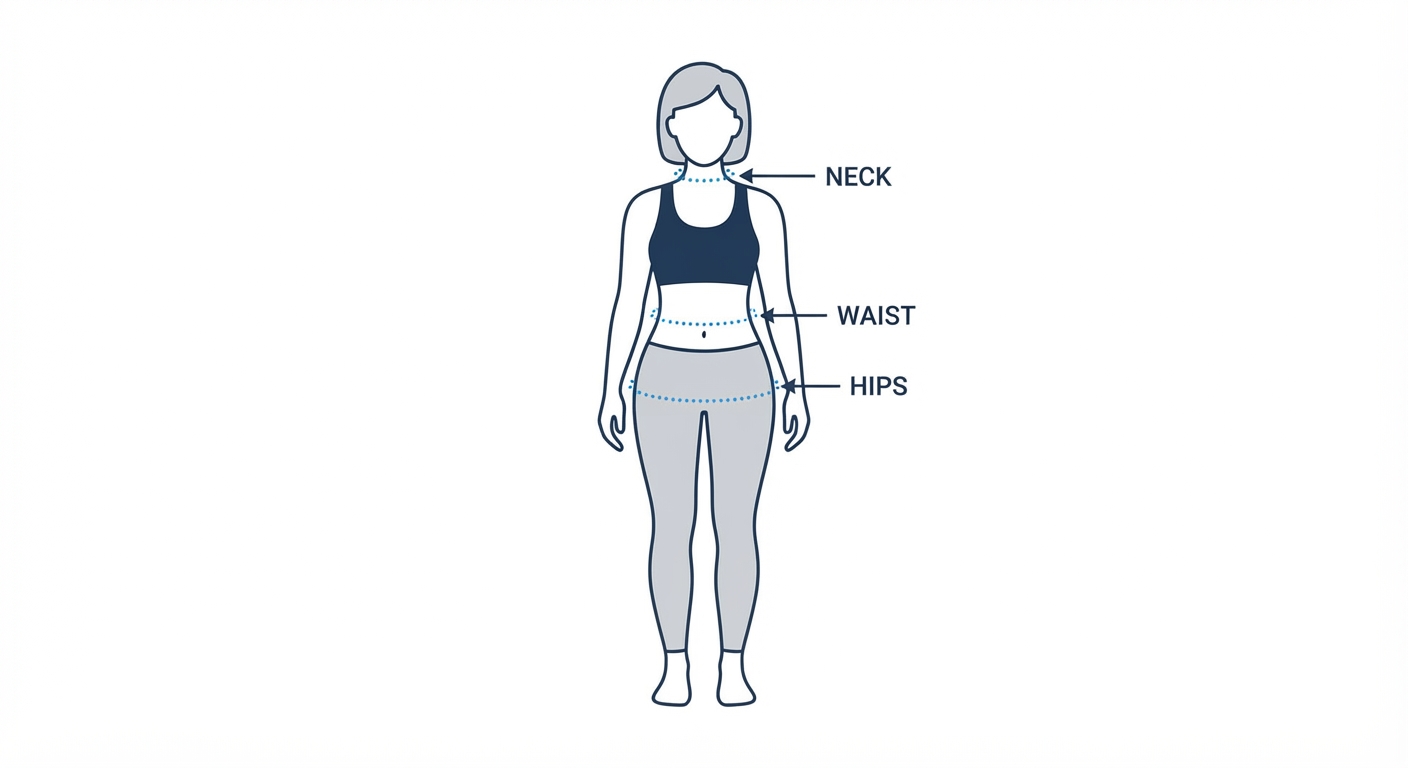
Calculating your body fat percentage with this tool is straightforward. You'll need a few key measurements and personal details to get an estimate based on established formulas.
To use the Calc Solutions Body Fat Calculator, gather the following data points:
- Age (years)
- Sex (male/female)
- Weight (pounds or kilograms)
- Height (inches or centimeters)
- Neck circumference (inches or centimeters)
- Waist circumference (inches or centimeters)
- Hip circumference (inches or centimeters) – for women only
Once you have these numbers, simply input them into the corresponding fields on the calculator. Ensure you select the correct units (imperial or metric) before clicking the 'Calculate' button. The tool will then process your data using the U.S. Navy Body Fat Formula to provide your estimated body fat percentage.
| Measurement | Unit (Imperial) | Unit (Metric) | Notes |
|---|---|---|---|
| Age | Years | Years | |
| Weight | Pounds (lbs) | Kilograms (kg) | |
| Height | Inches (in) | Centimeters (cm) | |
| Neck | Inches (in) | Centimeters (cm) | Measure at narrowest point |
| Waist | Inches (in) | Centimeters (cm) | Measure at navel (men), narrowest point (women) |
| Hip | Inches (in) | Centimeters (cm) | Measure at widest point (women only) |
For the most consistent results, take your measurements at the same time of day, ideally in the morning before eating or exercising.
To ensure your measurements are as accurate as possible:
- Use a flexible tape measure.
- Measure directly against the skin, not over clothing.
- Keep the tape snug but not tight enough to compress the skin.
- Take each measurement three times and use the average.
Formula
Estimating body composition relies on the U.S. Navy Method, which correlates circumference measurements with total body mass. By measuring the neck and waist for men—and adding the hip measurement for women—the formula isolates the lean mass component from the total weight.
The Navy Method Calculation
To find your body fat percentage, the calculation follows a specific sequence of subtractions and divisions based on your gender. The core logic relies on the difference between your waist and neck circumference, which serves as a proxy for abdominal fat distribution.
| Gender | Primary Inputs | Formula Logic |
|---|---|---|
| Men | Waist, Neck, Height | 86.010 × log10(waist − neck) − 70.041 × log10(height) + 36.76 |
| Women | Waist, Neck, Hips, Height | 163.205 × log10(waist + hip − neck) − 97.684 × log10(height) − 78.387 |
The Navy Method uses logarithmic scales because body fat does not accumulate linearly with circumference; it scales exponentially as the waist-to-neck ratio increases.
Key Variables and Constraints
- Circumference Units: Always measure in inches or centimeters, but ensure all inputs use the same unit system to avoid conversion errors.
- Measurement Precision: Pull the tape measure snug against the skin without compressing the underlying tissue to maintain accuracy.
- Logarithmic Base: The formula uses base-10 logarithms to normalize the relationship between height and girth.
If you find your result fluctuates, check your measurement consistency first. Because this formula relies on surface-level geometry, it cannot account for internal visceral fat density or bone structure variations.
Example
A 34-year-old male stands on the scale, grabs a inelastic tape measure, and records a height of 71 inches, a neck circumference of 15 inches, and an abdomen circumference of 36 inches. Entering those exact perimeter dimensions into the U.S. Navy circumference method yields a precise estimation of body composition rather than a vague fitness label.
To see how the math translates, we run those measurements through the standard male logarithmic equation. We convert the inch measurements into centimeters, calculate the difference between the abdomen and neck, and apply the base-10 logarithm required by the model.
| Measurement | Input Value | Metric Equivalent | Role in Formula |
|---|---|---|---|
| Height | 71 in | 180.3 cm | Vertical scale factor |
| Abdomen | 36 in | 91.4 cm | Primary fat-store circumference |
| Neck | 15 in | 38.1 cm | Lean-mass baseline |
Logarithmic estimators scale exponentially with waist expansion; a single extra inch on the tape alters the final percentage far more than a fraction of an inch on the neck.
Here is the step-by-step arithmetic breakdown for this profile:
- Step 1: Compute the log of the waist minus neck difference:
log10(91.4 − 38.1) = log10(53.3) ≈ 1.7267. - Step 2: Compute the log of height:
log10(180.3) ≈ 2.2560. - Step 3: Multiply the height log by $1.0334 and subtract
0.19077 × 1.7267plus the constant $98.700. - Step 4: Final output resolves to approximately
16.2%body fat.
Limitations
Why Tape Measures and Math Formulas Miss the Mark
A 210-pound powerlifter and a 210-pound couch surfer of the same height walk into a clinic. The tape measure treats them almost the same. If you use the US Navy circumference method—the math engine behind most online body fat calculators—the powerlifter's thick neck might skew the equation to make them look leaner than they are, while a thick waist on an athletic frame does the opposite. Math formulas estimate; they do not dissect.
The core issue with tape-based estimation is that it relies on equations built from specific population averages. If your bone density, muscle distribution, or fat storage patterns do not match those historical test groups, the output drifts.
| Method | Margin of Error | What It Actually Measures | Key Blind Spot |
|---|---|---|---|
| US Navy Tape Method | ±3% to 5% | Circumference proxies for volume | Misses visceral fat and bone density variances |
| Skinfold Calipers | ±3.5% to 5% | Subcutaneous fat thickness | Highly dependent on technician skill |
| Hydrostatic Weighing | ±1.5% to 2% | Total body density via water displacement | Assumes constant bone and muscle density |
| DEXA Scan | ±1% to 2% | X-ray attenuation of tissue | Expensive clinical access required |
The tape measure cannot distinguish between a square inch of dense, active muscle and a square inch of subcutaneous fat. It only knows how much space your body occupies.
Here is where the math breaks down for specific body types:
- The highly muscular athlete: Thick necks and heavy shoulders throw off the circumference ratios, often overestimating fat if the waist is also wide from heavy lifting.
- The "skinny fat" profile: Low muscle mass combined with high visceral fat (fat around internal organs). The tape might show normal circumferences, underestimating actual body fat and health risks.
- Recent weight fluctuations: Rapid water loss or glycogen depletion changes tissue volume without changing actual fat mass, leading to false progress readings.